The Recipe Trap: Treating Every Quantity as Untouchable
Recipe quantities are guides, not laws. Learn which amounts to follow closely, which to adjust by sight and taste, and how to choose your approach.
Recipe quantities are not all equally exact. A recipe may need a particular balance of flour and liquid, while its instruction to add salt “to taste” already expects you to make a judgement. The useful question is not whether to obey the recipe, but which quantities deserve precision and which ask you to pay attention.
Following every amount mechanically can produce a dish that is technically faithful and oddly wrong. Eggs vary in size, vegetables carry different amounts of water, and a lemon can be more or less sharp. Treat a recipe as a set of instructions with different levels of authority, rather than a contract written in teaspoons.
Three kinds of quantity
Most recipes combine structural amounts, adjustable amounts and estimates. Knowing which is which helps you choose between strict measuring, modest adjustment and active observation.
- Structural amounts shape how a dish holds together or cooks. In a cake, the relationship between flour, sugar, fat and raising agent matters. In bread, the balance of flour and water affects whether the dough can be handled and how it bakes. Large changes here are not ordinary seasoning adjustments.
- Adjustable amounts affect flavour or richness without usually defining the whole structure. Salt, lemon juice, chilli and herbs often belong here. You can add them in stages and taste the food as it develops.
- Estimates describe ingredients whose size or condition varies. “One onion”, “a handful of spinach” and “juice of a lemon” leave room for differences. The instruction tells you the intended scale, but the ingredient itself still has a vote.
A number alone does not reveal which category an amount belongs to. A spoonful of baking powder has a different job from a spoonful of chopped parsley. The surrounding method and the dish’s structure provide useful clues.
Strict measuring
Weighing ingredients is the sound choice when ratios do much of the work. Baking is the obvious case, but it is not the only one. A custard, set pudding or dumpling dough can also depend on proportions that are harder to judge by eye. A kitchen scale is more consistent than a cup measure when ingredients pack or settle differently.
Strict measuring suits a new recipe, a technically sensitive preparation or a cook who wants to understand its intended baseline before adapting it. Follow the stated units and method closely on the first attempt. If a recipe gives weights, use them rather than converting casually between cups and grams; the conversion can introduce another source of variation.
There is a limit to what exact weighing can solve. A measured amount of flour does not make every dough behave identically, because flour, humidity and handling can differ. Use the recipe’s texture cues as well as its numbers. If the dough is described as soft and pliable, that description matters alongside the quantity on the page.
Measured adjustment
For sauces, soups, dressings and many savoury mixtures, a good approach is to measure the starting amount and adjust in small additions. This respects the recipe’s balance without pretending that every ingredient tastes the same. It also makes it easier to notice what changed, rather than adding a fistful of something and hoping for a better outcome.
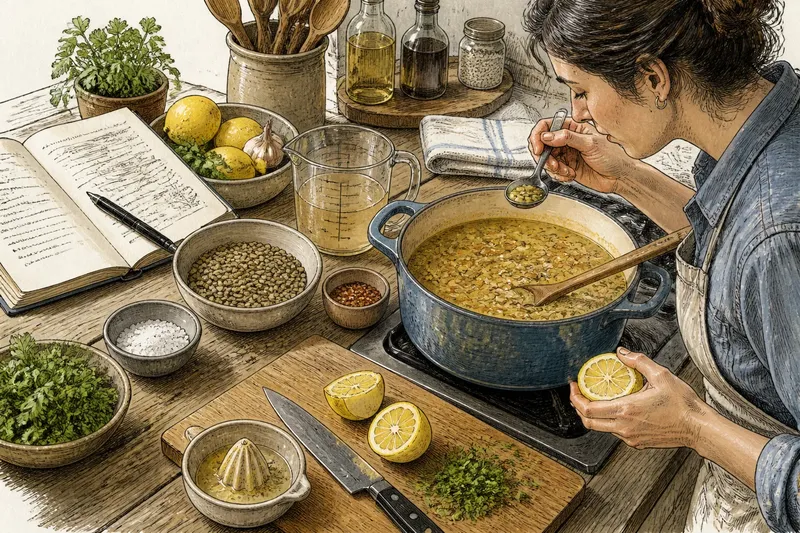
Imagine you are making a lentil soup from a recipe that calls for a whole lemon. If your lemon yields a sharp, abundant stream of juice, add some to the pot, stir, then taste before using the rest. The observable result you are aiming for is a soup with enough brightness to lift the lentils, not a fixed quantity of lemon juice. If the flavour is already distinct, stop.
This approach suits cooks who want a reliable starting point but are comfortable making small decisions. Keep the first adjustment modest, mix thoroughly and taste again. For salt, chilli or vinegar, this is especially useful: each can become conspicuous before the rest of the dish has had time to settle.
Cooking by cues
Some instructions are best read as a description of a result. “Add enough stock to loosen the mixture” is not a demand to use every drop in a measured jug. “Cook until tender” asks you to check the food, not trust the clock alone. The quantity or timing gives direction; the cue tells you when to stop.
This suits dishes with variable produce and flexible texture, such as a vegetable stew or a pan sauce. Watch how the ingredients behave. A watery courgette may release liquid as it cooks; a dry bean mixture may need more stock than the recipe suggests. Add liquid gradually when the aim is a particular consistency, and pause when the food has reached it.
Observation is not a licence to ignore the recipe’s structure. A loose instruction about stock is different from an invitation to double the flour in a cake. Use cues to refine a dish within its intended form, not to make a structural change without understanding the consequence.
How much should you adjust?
Which quantities should I weigh?
Weigh amounts that govern structure, especially in baking and set mixtures. If a recipe specifies weight, treat that as the clearest version of the instruction and avoid substituting an approximate volume measure.
Can I change salt to taste?
Usually, yes, but add it gradually and taste the whole dish after stirring. If the recipe relies on salt for curing, preserving or another technical purpose, flavour judgement alone is not enough.
What if my ingredient is larger?
For an ingredient described by count, consider whether its size changes the dish’s balance or cooking time. If it does, use part of it first, or adjust another flexible ingredient in response rather than assuming the count is exact.
Should I alter a recipe on the first attempt?
For a familiar, flexible dish, small adjustments are reasonable. For an unfamiliar or structurally sensitive one, follow the stated amounts first so you can tell whether a later change improves the result.
A simple choice
Choose strict measuring when an amount helps set the dish’s structure. Choose measured adjustment when the amount mainly tunes flavour. Choose cues when the recipe describes a changing texture, moisture level or degree of tenderness. A single recipe may call for all three approaches at different moments.
Before cooking, scan for words that signal flexibility: “about”, “to taste”, “as needed” and “enough to coat”. Then identify the ingredients whose proportions seem central to the dish. Keep those steady, and leave yourself room to respond to variable ingredients where the method invites it.
When a result is off, note the specific adjustment rather than rewriting the entire recipe in memory. “Used less lemon because the soup was already bright” is more useful than “the recipe needed less”. That small distinction turns cooking by observation into a decision you can repeat, instead of a new guess each time.
Recipe quantities work best as instructions with different degrees of precision. Weigh the amounts that hold a dish together, adjust flavour in small increments, and follow the food’s visible cues where the recipe leaves room. The recipe trap is not measuring; it is mistaking every number for an order that overrides what is in the pan.