The Long Journey of the Sandwich
The sandwich’s long journey shows how bread and filling became a portable meal, adapting to work, travel and local food traditions without one single origin.
How did the sandwich become a meal you can carry in one hand? The long journey of the sandwich is less a tale of one inventor than of a useful idea: put food between layers, then adapt those layers to the day, the place and the appetite.
That idea has appeared in many forms. Some meals use bread as a wrapper; others make a filling of what is left from supper, or turn a quick bite into a public ritual. These five shifts explain how the sandwich travelled without becoming one fixed thing.
1. A portable principle
Long before “sandwich” became a familiar menu word, people had practical reasons to enclose food. Flatbreads could fold around cooked meat, vegetables or sauces, making a meal easier to carry and keeping oily fingers away from other work. The arrangement was simple: a flexible layer on the outside, something sustaining within.
That does not make every wrapped or filled bread the same dish. A folded flatbread, a stuffed loaf and two slices of sliced bread each belong to their own food traditions. What connects them is a way of organising a meal, not a single recipe or common point of origin.
The distinction matters. Accounts that give the sandwich one universal birthplace often confuse a name with an older, broader habit. People can arrive at the same convenient answer independently: if bread is already on hand, it can carry whatever else is being eaten.
2. The name meets the format
The English word “sandwich” is associated with an eighteenth-century British nobleman, but the familiar story about its invention is not a reliable map of the dish’s beginnings. A named food can gain a label, travel through menus and print, and still rest on an idea that predates that label.
Once the name became useful, it gave cooks and customers a convenient category. A filling between slices could be ordered, described and varied without explaining the whole arrangement each time. The label was portable in its own right, even as the food beneath it changed.
Consider an invented situation: say a worker has cold roast meat and a loaf, but no time to sit at a table. Putting slices of meat between pieces of bread makes the meal easier to carry and leaves the hands cleaner. The expected result is practical, not culinary revelation; that is precisely why the format lasts.
3. Work shapes the filling
A sandwich often reflects the conditions under which it is eaten. A packed lunch needs ingredients that travel reasonably well and bread sturdy enough to hold them. A meal served at a counter can be messier, warmer or more elaborate because the eater need not carry it far.
These choices affect texture as much as convenience. Soft bread suits a delicate filling but may compress under a heavy one. A crusty roll holds up to generous juices, while a thin flatbread folds around its contents. The bread is not a neutral plate: it is part of the engineering, though nobody needs to say so at lunch.
Filling also follows the kitchen’s available food. Cold meat, cheese, pickles, beans and cooked vegetables can all become the centre of a portable meal. The sandwich therefore gives leftovers a different setting, not merely a second appearance. A roast served hot at supper becomes a lunch with its own balance of bread, seasoning and sharpness.
4. Local breads, local rules
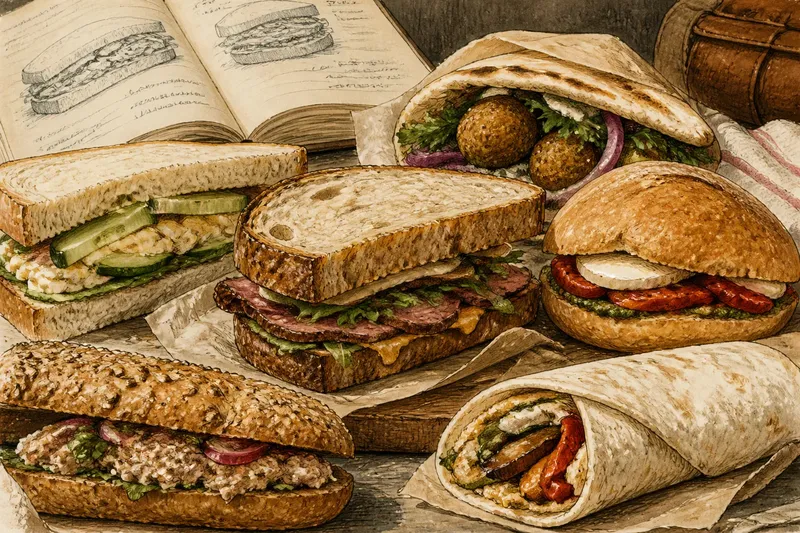
As the format moved between communities, it met breads already suited to local meals. A sandwich might use a long roll, a round bun, sliced bread or a flatbread folded around its filling. The choice shapes how the food is held, shared and eaten. There is no need for every version to resemble a neat pair of square slices.
Local ingredients give the format another accent. A filling can draw on preserved vegetables, cooked pulses, fresh greens, spiced meat or a regional cheese. What counts as a proper combination depends on custom and context. Some sandwiches are assembled for an individual; others are cut into pieces and set out for a group.
This adaptability can make the category seem almost too broad. Yet the shared feature remains recognisable: a bread or bread-like layer encloses, supports or accompanies a filling so the food can be handled as a unit. That is a useful family resemblance, not a rulebook.
5. From hand food to public meal
Portability did not keep the sandwich at work or on the road. Cafés, lunch counters and home tables made it a meal that could be ordered, dressed up or shared. Once served on a plate, it might be cut into halves, paired with soup or presented with a fork nearby. The hand-held meal had acquired table manners without surrendering its basic design.
That shift helps explain the sandwich’s range in contemporary food culture. It can be a plain lunch, a carefully composed café dish or a familiar centrepiece for a gathering. Its status comes less from a fixed list of ingredients than from the setting and the care given to the combination.
When choosing or making one, consider what the bread must do. Will it be carried, eaten immediately, shared or set down for later? A crisp, wet filling may be satisfying at a table but awkward on a walk. A softer combination may suit a packed lunch, provided the bread can support it. The sensible choice depends on the meal’s route as much as its recipe.
Questions about sandwiches?
Who invented the sandwich?
There is no sound basis for crediting one person with inventing the whole idea of food held between layers. The English name is linked to a British nobleman, but enclosed bread meals have broader and older roots in different food traditions.
What makes a sandwich a sandwich?
There is no universally accepted boundary. The useful common feature is a filling enclosed, supported or accompanied by bread or a similar layer so it can be handled as one meal.
Why is bread important?
Bread carries the filling, influences how easily the meal can be held and changes its texture. A sturdy roll and a soft slice of loaf solve different problems, so the bread is part of the dish rather than mere packaging.
Are wraps sandwiches?
Some people use “sandwich” broadly enough to include a filled wrap; others distinguish the two. The difference often reflects naming customs, menu conventions and the form of the bread, rather than a universal culinary test.
The long journey of the sandwich is visible in an ordinary decision: choose a layer that can carry a filling, then shape the combination for the place it will be eaten. That principle travels well because it leaves room for local bread, local ingredients and local appetites. The sandwich’s most durable feature is not a particular filling, but the useful space between its layers.